Different Types of Western Riding
Western riding is an umbrella term that covers several different types of riding. Competitions in this riding style vary by rules, style, and objectives. Overall, it challenges the rider and the horse to show skills ranging from precise dressage to rough-and-tumble cutting and roping. Many Western discipline competitions are built off existing English discipline competitions. Most events are speed events, but others are won by high scores. Judges will assess the horse's movements, correctness, rider's skill, and riding style.
Western Pleasure
Western Pleasure is a style of competitive riding with an overall objective of presentation. Horses must possess rhythm and unique mannerisms. Riders must navigate a pattern to show control and smooth transitions between gaits. The judges will assess the horse and rider's smoothness of movement, soundness of control, and overall attitude throughout the course. In Western Pleasure, a calm and relaxed demeanor will go a long way with the judges.
Western Horsemanship
Western Horsemanship is a style of competitive riding that tests a rider's ability to communicate with his horse. Riders must navigate a specific pattern to show control over various obstacles. The judges will assess the rider's position, use of aids, and the horse's overall balance and appearance. Ideally, the rider should be able to direct the horse effortlessly.
Western Showmanship
Western Showmanship tests a handler's ability to present his horse from the ground. Riders are not in the saddle for this competition; instead, handlers lead, groom, and control their horses through the show ring. Handlers must be calm and confident as they communicate with and lead their horses.
Reining
Reining horses is a competitive, scored event that challenges the athleticism of horses and riders. Riders guide their horses through a set pattern that involves:
-
Circles
-
Sliding Stops
-
Spins
-
Rollbacks
-
Flying Lead Changes
Not only must the entire course be performed with precision, but it also must be smooth and controlled. Due to the advanced complexity of reining, it is a popular favorite at competitions.
Cutting
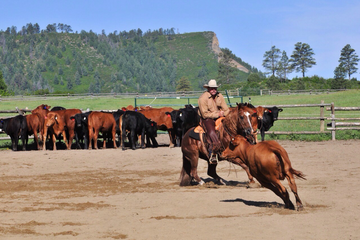
Cutting is a unique Western-style riding competition in which the rider and horse must separate a single cow from the herd. This competition is incredibly difficult because the rider must communicate with the horse quickly with little reins and the horse must respond very well to all cues. The judges will score the competitor based on the execution of the successful "cut" or separation, attitude, cow sense, athleticism, and demeanor.
Team Penning
Team Penning is another Western-style competitive rodeo event where riders work together in teams to herd cattle into a pen. Riders and horses must all work as a team to communicate and strategize. Specific cattle in the herd will be marked for the pen. The team must separate and pen these cattle. This is a timed event, but judges watch for quick thinking, agility, and responsiveness.
Breakaway and Team Roping
Breakaway roping is a single-rider rodeo event in which the rider ropes a calf, and the rope breaks away from the saddle as the calf moves. Riders must be skilled in roping and demonstrate quick reaction time to capture the calf.
Team Roping involves two riders working together to rope a steer successfully. One rider ropes the head of the steer while the other ropes the heels. Timing and teamwork are crucial in this competition.
Working Equitation
Working Equitation mimics real-world Western horseback riding. Riders navigate through a course to avoid and traverse obstacles. They may also face challenges such as gates or bridges. This challenges the relationship between horse and rider. Additionally, the rider must be able to adapt to new challenges.
Competitive Trail Riding
Competitive trail riding is a great way to build a relationship between horse and rider. All trail-riding competitions test the team's agility, strategy, and adaptability. Western trail riding combines the skills of Western riders with the leisure of ranch life. It offers a distinctive blend of leisure and skill, emphasizing the bond between rider and horse. This discipline includes various competitive events that showcase technique, agility, and strategy.
Cowboy Mounted Shooting
Cowboy-mounted shooting challenges Western riders to maintain a seat in the saddle while shooting at targets. Using a single-action revolver, the rider must navigate a specific course while shooting balloons. This is a challenge not only in horseback riding but also in shooting. The horse must be trained to maintain a pace even without bridle guidance.
Pole Bending & Barrel Racing
Pole bending is a rodeo-style event. It is timed and challenges racers to weave through six upright poles as fast as possible. Riders must bend their horses tightly around a series of poles in a straight line. The rider's ability to steer and maintain the horse’s speed will make a big difference. In the end, the fastest time, without any faults, wins.
Barrel racing is a high-energy, popular rodeo competition. Riders must race their horses around three barrels in a clover-leaf pattern. This fast-paced competition has almost no room for error. Time penalties are given for knocking over barrels. The fastest time wins.
Western Dressage
Western Dressage is a horse riding discipline that builds on traditional English dressage and incorporates Western riding style. In dressage, the rider must guide his horse through a series of tests. These tests can include:
-
Basic Transitions
-
Circles
-
Lateral Movements
Riders use a Western saddle and tack and compete to demonstrate high-level precision in communication and commands. In Western dressage, a strong relationship between the horse and rider helps them earn the best score as they execute the mandatory movements with poise.
Western Versatility
Western versatility refers to the ability of riders and horses to compete in several different Western riding disciplines. Events that are part of Western Versatility are:
-
Ranch Riding
-
Ranch Reining
-
Ranch Cutting
-
Ranch Cow Work
-
Ranch Conformation
Judges will assess each horse-rider team on communication, adaptability, smoothness and control. Competitors can use these events to demonstrate their versatility in multiple Western disciplines.


